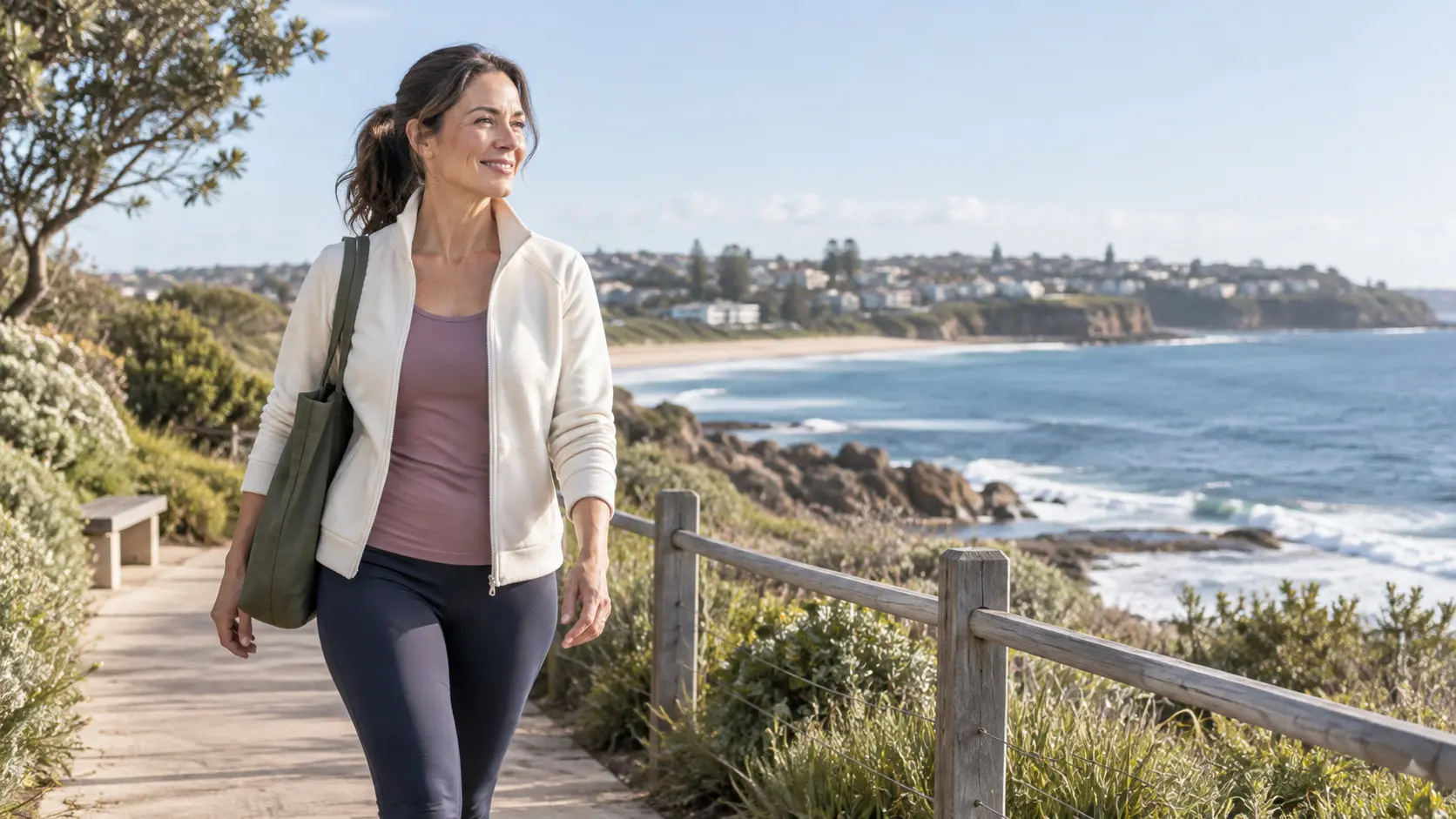
Bladder leaks during exercise: how to stay active and choose support that fits your day
Bladder leaks can turn an ordinary walk, exercise class, workday or trip away from home into a series of calculations.
Where is the nearest toilet? What will feel comfortable? Will there be somewhere to change?
These decisions are more common than many people realise. An Australian survey of 4,556 women with pelvic floor symptoms found that 46% had stopped at least one form of exercise because of their symptoms and more than half had changed the way they exercised. The effect was seen across age groups, including younger women and women who had not given birth.
For Women’s Health Week 2026, Continence Health Australia is encouraging women to keep moving with confidence and to include pelvic floor health in ordinary health conversations.
At a glance
- Bladder leakage during exercise is common and help is available. It does not automatically mean you need to stop moving.
- A health professional can help assess why leakage is happening.
- Continence products can help manage the practical side while you exercise, work, travel or move through your day.
- For an active routine, look beyond absorbency alone. Fit through movement, breathability, discretion, changing access and comfort all matter.
Why do bladder leaks happen during exercise?
Leakage with coughing, sneezing, laughing, lifting, jumping, walking or running can be a feature of stress urinary incontinence.
Bladder leakage can be associated with pregnancy and childbirth, menopause, pelvic or abdominal surgery, pelvic organ prolapse and other health factors. Pelvic floor function can also differ from person to person which is why the same advice is not appropriate for everyone.
A GP, nurse continence specialist or pelvic health physiotherapist can help assess what is happening and discuss support suited to the individual.
Should you stop exercising if you have bladder leaks?
Bladder leakage does not automatically mean you need to stop moving.
If bladder leakage is changing what you feel comfortable doing, professional support can help you understand the symptoms. At the same time, practical continence support can help you manage the day in front of you.
Two kinds of support can work together
Support for the underlying symptoms
A health professional can help assess the type and cause of leakage and discuss appropriate options.
Pelvic floor physiotherapy or other approaches may be recommended depending on the individual. That assessment belongs with a qualified health professional.
Practical support for everyday life
Continence underwear and other absorbent products can help manage leakage while someone remains active or seeks professional support.
They do not diagnose the problem or replace professional advice.
Their role is practical: helping a person dress, leave home, move through the day and feel prepared.
Continence pads, disposable pull-ups and washable absorbent underwear may suit different people and different routines. The practical checks below focus on pull-up continence underwear.
What should you look for in continence underwear for an active day?
For an active day, look for enough absorbency for your usual output as well as a fit that remains comfortable through movement and a realistic plan for changing and toilet access.
1. A fit that works while you move
A product may feel fine while you are standing still but behave differently once you sit, bend or walk.
Check whether:
- the waistband stays level without feeling unnecessarily tight
- the leg openings sit close without digging in
- the absorbent area stays centred
- the product avoids excessive twisting or bunching
- the size still feels comfortable after sitting and moving
The largest size is not automatically the most comfortable and the smallest size is not automatically the most secure. Body shape and fit preference matter alongside the measurement.
2. Breathability during longer periods of wear
Movement, warm weather and time away from home can make a closed-in product feel more noticeable.
During longer wear, breathability is mainly a comfort consideration. When comparing products, look for clear information about where breathable materials are used and whether the product suits the length and conditions of your usual day.
For more detail, read What makes continence underwear feel bulky, hot or restrictive.
3. Discretion under normal clothing
An active day may involve work trousers, activewear, travel clothing or something worn for a social occasion.
Consider the product’s profile under clothing, whether it rustles during movement and whether it feels easy to incorporate into getting dressed.
Discretion is not only about what other people can see. It is also about how much you notice the product yourself while moving through the day.
4. Absorbency that matches the routine
It can be tempting to choose the highest absorbency number available simply for reassurance.
Higher-capacity products can be appropriate where output is heavier, overnight needs are greater or changing is difficult.
For routine daytime wear, it can be more useful to consider:
- usual output
- how long you will be away from home
- whether changing facilities will be available
- whether changes are practical during the activity
- whether the same product is also expected to cover overnight needs
The aim is not to choose the lowest absorbency. It is to choose enough support for the circumstances while also considering fit, movement, comfort and discretion.
For more detail, read Why the highest absorbency is not always the best choice.
5. An easier change plan
Think about where and how the product will be changed before you leave home.
For longer outings, it can help to carry enough products and spare clothing and know where toilets are likely to be available. Australia’sNational Public Toilet Map can help you check locations, opening hours and available facilities.
Tearaway sides can make a used disposable pull-up easier to remove. A fresh pull-up still needs to be stepped into, so trousers and shoes may need to come off. Practise the whole change at home in the clothing you plan to wear.
Before a longer day out: check fit, changing and access
Svelte’s practical active-day check is simple:
Fit. Changing. Access.
Fit: Does the product still feel comfortable when you sit, stand and move?
Changing: Can you remove the used product, put on a fresh one and manage disposal or storage in the space available?
Access: Where are suitable toilets and will they be open when you need them?
Those three questions can often be more useful than looking at absorbency in isolation.
A 60-second active-day fit check
Before relying on a new product for a longer outing, try this simple product fit check at home. Take a little longer if you need to and use only movements that feel comfortable.
- Pull the product up fully and make sure it sits evenly.
- Stand and walk for several steps.
- Sit down and stand again.
- Bend gently as you would when dressing or reaching for something.
- Check the waistband, leg openings and absorbent area again.
This is a product fit check rather than a test of absorbency or leak performance. It does not assess whether exercise is appropriate for you and it cannot show how a product will perform in every situation.
Its purpose is to help you notice obvious gapping, pressure, rolling, shifting or bunching before relying on the product for a longer period.
If the product gaps, digs in or shifts, check the size and the manufacturer’s fitting instructions or ask the supplier for guidance. Before a longer outing, try a short period of familiar activity with an easy opportunity to change. Notice both comfort and how well the product suits your usual leakage.
Where Svelte may fit
Svelte is disposable pull-up continence underwear designed in Australia and crafted in Japan for mobile and semi-mobile adults seeking support for everyday wear.
It is fully breathable through to the waist with soft-touch materials, an adaptive stretch waistband and soft, raised and flexible leak guards. Its fast-absorbing core is designed to draw in and disperse liquid quickly.
Svelte is designed for everyday wear and may support light overnight use when changed as required. Suitability depends on individual output, fit and changing routine.
It may not be the best primary option where maximum overnight absorbency is the main priority, extended uninterrupted overnight wear is needed, regular or unpredictable faecal incontinence is present or the person is mostly bed-based.
For general sizing guidance, use Find Your Fit.
What about bladder leaks after birth or around menopause?
Pregnancy, childbirth, perimenopause and menopause can all be associated with changes in bladder or pelvic floor function.
If bladder leakage is happening after birth, product needs may also involve postpartum bleeding, tenderness, changing body shape and recovery after vaginal or caesarean birth.
Those considerations are covered separately in Svelte’s Postpartum pull-up underwear after birth guide rather than being repeated here.
Around menopause, new or changing bladder symptoms are worth discussing with a health professional rather than assuming they are simply part of ageing. For the practical day, reassess output, fit and changing access rather than automatically moving to maximum absorbency.
When should you seek professional support?
Speak with a health professional if bladder leakage is new, changing, difficult to manage or affecting activities you would normally enjoy. Pelvic pain, heaviness or pressure during activity also deserves professional assessment.
Seek medical advice if you have symptoms such as pain or burning when passing urine, blood in your urine, difficulty emptying your bladder or a significant unexplained change in bladder habits.
If your bladder feels full but you cannot pass urine at all, seek urgent medical care.
The National Continence Helpline provides free and confidential information, advice and support from nurse continence specialists on 1800 33 00 66.
Keep moving in the way that works for you
Managing bladder leakage should not mean every decision about your day revolves around continence.
Professional support can help you understand and address the symptoms.
Practical continence support can help with the immediate realities of getting dressed, leaving home and feeling prepared.
Ready to explore Svelte?
View Svelte pull-upShops for product features or use Find Your Fit for general sizing and starting-pack guidance.
Frequently asked questions
Is bladder leakage during exercise common?
Yes. Bladder leakage during exercise is common but it should not simply be dismissed as something you have to accept. A health professional can help assess what may be contributing to it and discuss appropriate support.
Does exercise leakage always mean a weak pelvic floor?
No. Pelvic floor function is more complex than strength alone. Timing, coordination and muscle tension can also matter. A pelvic health professional can assess an individual’s symptoms and pelvic floor function.
How should continence underwear fit when you sit, bend and walk?
It should remain comfortably positioned through ordinary movement. Look for a waistband that stays level, leg openings that sit close without digging in and an absorbent area that remains centred without excessive twisting or bunching.
Is maximum absorbency always best for an active day?
Not necessarily. The right level depends on usual output, how long you will be away from home and whether changing is practical. Fit, movement, comfort and discretion also matter.
Can continence underwear treat bladder leakage?
No. Continence underwear helps manage leakage. It does not assess, diagnose or treat the underlying cause.
Sources and further reading
- Continence Health Australia, Women’s Health Week
- Continence Health Australia, When pelvic floor symptoms affect exercise
- Continence Health Australia, Stress incontinence
- Jean Hailes for Women’s Health, Urinary incontinence
- Healthdirect Australia, Urinary incontinence
- Healthdirect Australia, Urinary retention
- Dakic JG et al. Pelvic floor disorders stop women exercising: a survey of 4556 symptomatic women. Journal of Science and Medicine in Sport. 2021;24(12):1211–1217.
- Australian Government Department of Health and Aged Care, National Public Toilet Map, National Public Toilet Map


