
Men’s incontinence underwear: how to choose the right everyday pull-up
Searching for men’s incontinence underwear can make the choice look simpler than it really is.
You will find guards, washable underwear, disposable pull-ups and higher-capacity products. Absorbency figures are often prominent. What is less obvious is how differently those products can work once you are actually wearing them, moving in them and changing them.
For everyday use the better question is not simply “Which product holds the most?”
It is:
What type of support fits the way I actually live, move and change?
Continence Health Australia notes that product options vary by the type of incontinence, physical ability, lifestyle and budget. Products also differ in absorbency, fit and style.
That makes the starting point your routine, not the number on the packet.
Guard or pull-up: which format suits your needs?
A guard and a pull-up do different jobs.
Pads and male guards are worn inside close-fitting underwear rather than replacing the underwear itself. Male guards typically concentrate protection around the front and some are specifically shaped around male anatomy. This can make sense for lighter or more predictable leakage when you are comfortable continuing to wear your usual underwear.
A pull-up, sometimes described as an adult pull-up, gives broader coverage. It is worn as the underwear itself rather than being attached inside another garment.
Australian continence ranges include both male-specific products and unisex pull-ups. This is useful because a product does not necessarily have to be labelled specifically for men to work for a male wearer.
A pull-up may be practical when you want broader protection through everyday movement or when a smaller guard is no longer enough for your usual leakage pattern.
Neither format is automatically better.
The useful question is whether you need targeted front protection or broader all-around support.
Disposable or washable underwear?
Washable continence underwear can work well when leakage is lighter and you are comfortable managing the washing and drying routine.
Disposable pull-ups remove the laundry step. That can be particularly useful at work, while travelling or where another person assists with continence care.
There are practical trade-offs with both.
With washable underwear you need enough pairs to cover washing and drying time. If you change away from home you also need somewhere to store the used product until you return.
With disposable underwear you need to carry spares and have an appropriate way to dispose of the used product.
Continence Health Australia recognises both disposable and reusable products as legitimate options rather than treating one format as the answer for everyone.
Some people may find that different formats suit different parts of their routine.
For a broader look at choosing a disposable pull-up, see How to choose disposable continence underwear.

Does incontinence underwear have to be designed specifically for men?
Not necessarily.
Some products designed specifically for men use a shaped front or concentrate more absorbency towards the front. That can be useful for some leakage patterns.
A well-fitting unisex pull-up can also suit men. What matters is whether there is enough comfortable room through the front for the anatomy to sit naturally while the absorbent area and leg openings remain properly positioned.
That does not require a pronounced male pouch. A balanced unisex fit can provide room where it is needed while remaining close and discreet overall without creating unnecessary bulk through the front.
The useful test is the whole fit. It should not feel compressed through the front, create obvious gaps around the legs or require repeated adjustment as the wearer sits, walks and bends.
Does penis position matter in incontinence underwear?
There is no single position that will suit every man or every product.
The penis may sit up, down or slightly to one side and its position may shift naturally with movement depending on anatomy and the shape of the garment. The aim is not to force it into a prescribed direction simply because that seems to be where the absorbent section sits.
Instead, check the garment as a whole.
The anatomy should sit comfortably while the absorbent area remains appropriately positioned and the leg openings stay close to the body.
Once the pull-up is on, sit, stand, walk and bend. If the wearer needs to keep repositioning himself, feels compressed through the front or notices gaps or leakage around the legs, it may be worth checking the size, fit or product format.
How should a men’s pull-up fit? A 60-second real-day check
Continence underwear can look perfectly fitted while you are standing still and behave differently five minutes later.
A useful fit check should include:
- Front: Is there comfortable room without excessive looseness or compression?
- Waist: Does it sit flat and securely without rolling or digging in?
- Legs: Are the openings close to the body without obvious gaps?
- Core: Does the absorbent area stay centred rather than twisting or bunching?
- Movement: After sitting, standing, walking and bending does the fit still feel secure?
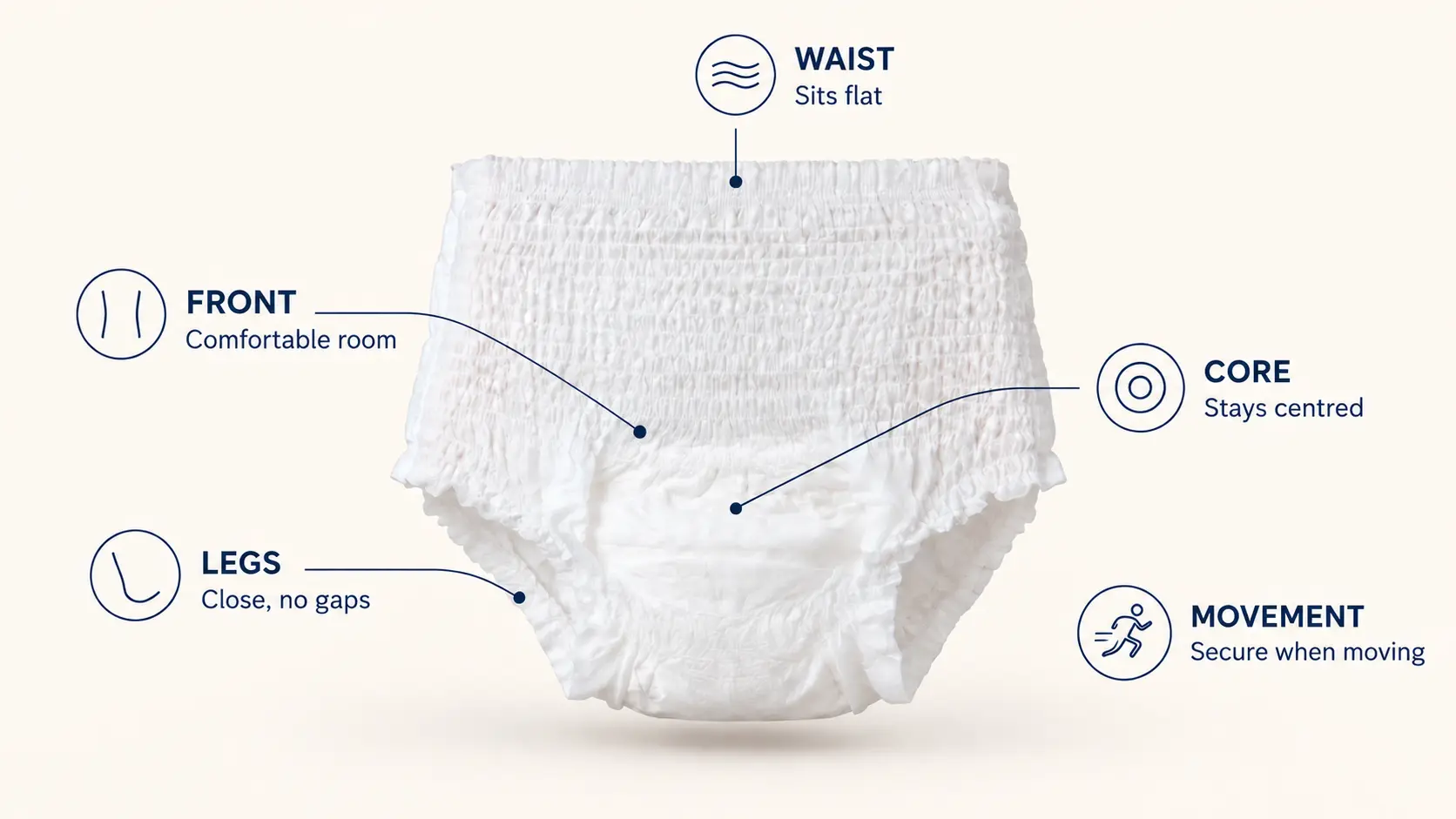
This kind of check is often more informative than judging a pull-up by waist measurement alone.
A pull-up also has to cope with being pulled on
Pull-ups are handled firmly during dressing.
Someone may grip the waistband or sides and pull the garment up several times to get it properly positioned. This can be even more noticeable when a carer or support worker is helping with dressing.
A pull-up that tears accidentally during this process can be frustrating and wasteful.
At the same time tearaway side seams have an important purpose when the product needs to come off.
These are two different requirements.
During dressing the garment needs to hold up through normal pull-on handling. At change time the side seams should be able to open deliberately for easier removal.
That distinction is worth considering when comparing products.
Softness during wear and sufficient strength during dressing are not opposing ideas. A product can be soft against the body without feeling flimsy when it is being handled.
How much absorbency do you actually need?
This is where product comparison can become confusing.
Large absorbency numbers are easy to compare. Real-life wear is not.
The amount a person leaks can vary significantly. So can the time between changes.
A useful way to think about absorbency is:
How much urine needs to be managed between realistic opportunities to change?
That may mean occasional smaller leaks for one person and repeated bladder releases for another.
It may also change throughout the day.
Someone who can change regularly may have very different requirements from someone who has limited access to a toilet or assistance.
This is why maximum absorbency alone does not tell you whether a product is the right everyday choice.
Can you pass a full bladder release into incontinence pants?
Some pull-ups are designed to manage substantial bladder releases.
That does not mean every pull-up will contain every full bladder release in every situation.
People have different bladder volumes. Products also differ in capacity, intake speed, construction and fit.
The garment may already contain urine from an earlier leak. Sitting or movement can also affect how the product is positioned when another release occurs.
A capacity figure is therefore useful information but it should not be read as a universal guarantee.
If larger or repeated bladder releases are part of your normal routine look for a product with enough practical capacity between changes.
If you consistently need substantially greater capacity then a higher-capacity product may simply be the better choice.
More absorbency is not automatically better for daytime wear
Higher-capacity products have an important place. For heavier output, long periods between changes or overnight use, a higher-capacity option may be exactly what is needed.
For daytime wear, other factors can matter just as much. You may be sitting at a desk, getting in and out of a car, walking, working or travelling while wearing the product underneath normal clothes. Thickness, warmth, movement, fit and discretion can become more noticeable across an ordinary day.
The aim is to choose enough absorbency for your actual output and changing routine without assuming that the highest capacity is automatically the best everyday fit.
Svelte explores this in more detail in Why the highest absorbency is not always the best choice.
What does everyday comfort mean after several hours?
Comfort is not only about softness when you first touch the product.
Think about what happens after several hours.
Does the waistband become noticeable when you sit?
Does the garment feel hot?
Does the core bunch or become concentrated in one place?
Does the product make noise when you move?
Does it remain discreet underneath your normal clothing?
Do you keep adjusting it?
A product worn against the body through ordinary daily activity needs to work while the body changes position.
Fit, materials, breathability and how the core behaves all contribute to that experience.
For a deeper look at these factors see What makes continence underwear feel bulky, hot or restrictive.
Changing away from home: think beyond the spare pull-up
It is easy to think about what you will wear and forget about what happens when it needs changing.
For a day away from home it can help to plan for a fresh product, disposal, clothing and somewhere private enough to manage the change.
Disposal is particularly relevant for men.
BINS4Blokes is a Continence Health Australia campaign focused on increasing access to disposal bins for continence products in male public toilets. Its resources also encourage suitable bin locations to be recorded on the National Public Toilet Map.
That tells us something important about real-world product use: the change itself is part of choosing the product.
Taking a used pull-up off is different from putting a fresh one on
Tearaway side seams can make a used pull-up easier to remove because the garment can be opened at the sides rather than pulled back down over the legs.
A fresh closed pull-up still needs to be stepped into like underwear.
So a complete change may involve managing trousers and possibly footwear as well as balance and privacy.
This may not matter much for someone who dresses independently.
It can matter considerably for someone who needs assistance.
If you are choosing continence support for someone else, see Choosing for someone you care for, which looks more broadly at mobility, changing and everyday routine.
If a person finds standing or walking difficult another product format may sometimes make changing easier. Continence Health Australia notes that wrap-around all-in-one products can be helpful for people who find it difficult to stand or walk.
The practical question is:
How does the used product come off and how does the fresh product go on?
Both parts matter.
Can the same pull-up work during the day and overnight?
Sometimes.
It depends on output, fit and how often changing is realistic.
Daytime wear often includes more movement and more opportunities to change.
At night the period between changes may be longer. Output may also be different and the product is exposed to different sleeping positions and periods of pressure.
A daytime pull-up does not need to be an all-night product to be useful.
Some people may find that one product works for daytime use and light overnight use when changed as required.
Others will be better served by a separate higher-capacity overnight product.
A split routine can be a sensible solution.
For more detail on matching products to different times of day, see Daytime vs overnight continence products.
What about continence underwear after prostate surgery?
Men looking for continence underwear after prostate surgery often have a slightly different decision to make because leakage needs may change during recovery. Rather than duplicating that subject here, Svelte has a separate guide: Continence support for men after prostate surgery.
If you are having trouble controlling your bladder, Healthdirect advises speaking with your doctor. A continence health professional can also provide further support.
What if bowel leakage is also occurring?
Urinary and bowel incontinence should not automatically be treated as the same product need.
A pull-up designed primarily around urine may not be the most appropriate product for regular or unpredictable bowel leakage.
Different containment and changing requirements may be more important.
Where bowel leakage is regular or difficult to manage it can be useful to speak with a continence health professional about appropriate product formats.
The National Continence Helpline is a free Australian service staffed by nurse continence specialists on 1800 33 00 66.
Where Svelte may fit
If an everyday pull-up suits the routine described above, this is where Svelte may fit.
Svelte is a premium disposable unisex pull-up continence underwear designed in Australia and crafted in Japan.
Format
Disposable unisex pull-up continence underwear
Designed and made
Designed in Australia and crafted in Japan
Who it may suit
Mobile and semi-mobile adults who can stand or participate in dressing
Fit
Underwear-like pull-up with an adaptive stretch waistband
Sizes
Medium 75–130 cm · Large 100–140 cm
Breathability
Fully breathable through to the waist
Core and protection
Fast-absorbing core with soft, raised flexible leak guards
Working capacity
Approx. 500 mL conservative practical working capacity. This is not a maximum laboratory absorbency claim or guaranteed wear time.
Use
Daytime and light overnight use when changed as required
May not be the right format for
Extended uninterrupted overnight use, ongoing unpredictable or high-volume faecal incontinence or mostly bed-based care
For men, Svelte uses a balanced unisex fit designed to allow comfortable room through the front while keeping the absorbent area, waistband and leg openings appropriately positioned. The intention is a close, discreet overall fit without unnecessary bulk through the front.
Final fit should consider body shape as well as measurement. Fit, movement, output and changing routine still matter.
If Svelte looks like it may suit your routine, use Find Your Fit to check sizing and everyday-use guidance.
Frequently asked questions
Can men wear unisex incontinence underwear?
Yes. Unisex continence underwear is already an established product format in Australia.
What matters is the fit. Male anatomy should have enough room to sit naturally while the absorbent area and leg openings remain appropriately positioned.
Are guards or pull-ups better for male bladder leakage?
It depends on the leakage pattern and the way you prefer to manage it.
A guard may suit lighter or more targeted leakage when you want to keep wearing your own underwear.
A pull-up may suit someone who wants broader coverage and an all-in-one underwear-like garment.
Does more absorbency mean better protection?
Not automatically.
Enough absorbency is important. So are fit, changing opportunities and how the product behaves during movement.
If your current product repeatedly reaches its practical limit then greater capacity may be needed. If it comfortably manages your normal output between changes then other factors such as fit and wearability may matter more.
How often should incontinence pants be changed?
There is no single change interval that suits everyone.
Output, skin comfort, activity, sitting time and the individual care routine can all affect change frequency.
Can I change a pull-up without removing my trousers?
You may be able to remove a used pull-up more easily if it has tearaway sides.
A fresh closed pull-up still needs to be stepped into. This means trousers need to be managed and footwear may also need to come off depending on what you are wearing.
Are urinary pull-ups suitable for bowel incontinence?
Yes. A pull-up can provide containment when bowel leakage occurs, although suitability depends on the type, amount and predictability of the leakage as well as the person’s changing routine.
Svelte is designed for everyday continence support rather than as a dedicated product for regular or unpredictable bowel incontinence. In those situations, another product format may be more appropriate.
Choose for the day you actually live
There is no single best men’s incontinence underwear for everyone.
For one person a guard may be enough.
Another may prefer washable underwear.
Someone else may want a disposable pull-up that provides broader support while still fitting comfortably underneath everyday clothing.
A person with higher output, limited mobility or more complex continence needs may be better served by another format altogether.
Start with your day.
What needs to be managed? How do you move? When can you change? What feels comfortable to wear?
Then choose the product around those answers.
Looking for an everyday pull-up?
See whether Svelte may suit your routine, body shape and everyday needs.


